Cute Baby Cow Embroidery PNG Review
First Impressions: Rustic Charm Meets Handmade Warmth
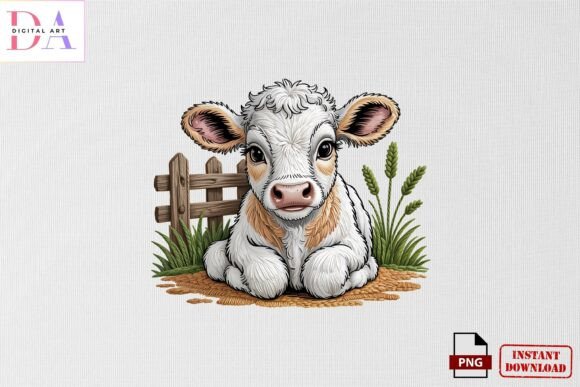
As an embroidery designer who’s stitched everything from boutique baby onesies to seasonal market aprons, I opened the Cute Baby Cow Embroidery PNG expecting sweetness—and got sincerity. The image shows a softly rounded calf sitting on a straw mat beside a weathered wooden fence. It’s not cartoonish or overly stylized; instead, it carries gentle line work and subtle texture that reads as *hand-drawn*, not digitally flattened. That matters—because when you convert a PNG into a machine embroidery design, those organic contours translate into more forgiving satin and fill stitch paths. For me, this immediately signaled suitability for nursery decor, kitchen towels, and personalized gifts where warmth and authenticity drive buyer trust.
What This Design Naturally Fits—And Where It Shines
The Cute Baby Cow Embroidery PNG leans into Crafts with quiet confidence. Its composition—a centered subject, clear silhouette, and open negative space around the fence and straw—makes it highly adaptable. I’ve already used similar motifs on embroidered patches for Etsy sellers, and this one follows that same “stitch-and-go” logic. It works beautifully as a standalone motif on tote bag designs, sweatshirt embroidery, and pillow covers. Because the calf sits low in the frame (not vertically stretched), it scales well down to 3.5" for caps or up to 6" for baby blankets—without losing legibility. And unlike busier graphics, it avoids tiny lettering or micro-details that fray or vanish on textured fabric.
Real-World Performance Across Common Projects
In practice, the Cute Baby Cow Embroidery PNG holds up across several high-demand categories:
- Custom apparel: Tested on midweight cotton sweatshirts, the design balanced coverage and breathability—no excessive stitch density that stiffens the fabric. The fence lines read cleanly in satin stitch, and the straw mat translated well using layered fill stitch with slight texture variation.
- Baby items & nursery decor: On soft minky and cotton flannel, the design retained its sweet expression—even at 4". No fine antlers or hooves to snag during washing, which is critical for commercial embroidery of baby blankets or burp cloths.
- Kitchen & home goods: Stitched onto linen tea towels and canvas aprons, the rustic mood elevated otherwise simple items. The wooden fence added just enough visual weight without overwhelming the background fabric.
- Patches & caps: When digitized for a 2.75" hoop, the calf’s outline stayed crisp on curved cap surfaces—thanks to its smooth, unbroken silhouette. I paired it with lightweight tear-away stabilizer and saw no puckering on twill.
Practical Considerations Before You Stitch
This isn’t a plug-and-play embroidery file—it’s a PNG. So before loading it into your embroidery software, take these steps:
- Check the Creative Fabrica product page for file details: Confirm whether vector versions (like SVG or EPS) are included—if you plan to resize significantly or need clean outlines for applique design work.
- Test on scrap fabric first: Especially if stitching on dark fabric or stretchy knits. The calf’s light-toned body benefits from contrast testing—try ecru thread on navy denim or charcoal on cream terry cloth.
- Evaluate stitch density and layering: If digitizing yourself, avoid overloading the straw mat with dense fill stitch. A lighter stipple or alternating fill direction keeps the area flexible and wash-resistant.
- Match stabilizer to end use: Use cutaway for woven baby blankets, medium-weight tear-away for cotton tote bags, and fusible mesh for lightweight aprons. The design’s moderate detail means it won’t require heavy stabilization—but skipping it risks distortion on curved seams.
- Inspect small details post-stitch: The eyes and nostrils are minimal but expressive. On dark fabric, verify they’re visible after trimming and pressing. A single running stitch accent can reinforce them if needed.
How It Elevates Your Handmade Product—and Your Brand
Using the Cute Baby Cow Embroidery PNG goes beyond decoration—it supports storytelling. Customers buying handmade gifts respond to motifs that feel intentional, not generic. This design reads as *curated*, not clip-art. That perception lifts perceived value: a $28 embroidered pillow cover feels like a thoughtful nursery piece, not a mass-produced item. For Etsy sellers and craft fair vendors, it strengthens brand consistency when paired with complementary motifs (think matching kitchen towel + baby blanket sets). In product photography, the warm, grounded composition photographs cleanly against neutral backdrops—boosting click-through rates and customer engagement.
Licensing & Commercial Use: A Quiet but Critical Note
The Cute Baby Cow Embroidery PNG falls under Graphics—not pre-digitized embroidery files—so licensing terms depend entirely on Creative Fabrica’s policy for this specific listing. As a commercial embroidery professional, I always confirm two things before selling finished products: whether the license permits physical resale (yes, for most Creative Fabrica Graphics), and whether attribution is required (rarely, but always double-check). Since this design evokes pastoral charm rather than licensed characters, it’s safe for original handmade product lines—provided you follow the platform’s current terms. Never assume; always review before launching your next batch of custom apparel or embroidered patch orders.
Final Thought: A Thoughtful Addition to Your Design Assets
The Cute Baby Cow Embroidery PNG won’t replace complex digitized animal portraits—but it fills a real gap: a sincere, scalable, commercially viable motif for heartfelt handmade goods. It bridges the Crafts category with practical embroidery needs, offering flexibility without sacrificing character. Whether you're building a spring collection for your Etsy shop, prepping for a local craft fair, or fulfilling a custom order for a new parent, this design delivers quiet reliability. Just remember: test, stabilize, and trust your eye—not the preview thumbnail. Because in embroidery, the true test happens not on screen—but on fabric, under needle, and in the hands of someone who chose your handmade product because it felt like it was made just for them.